Landing Performance Abbreviation FSL A320
FSL A320 EFB requierd!
This document is only for the FSLabs A320 Family EFB Addon
Download PDFSection Overview
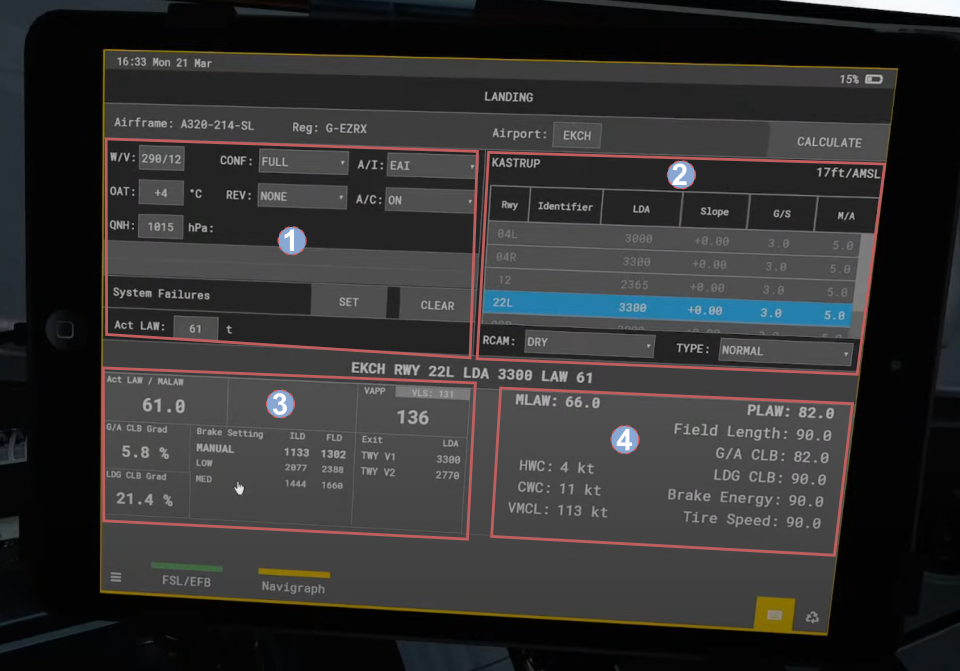
Section 1
Act LAW | Actual Landing Weight |
VMCL | Minimum Control Speed Landing. This is the lowest speed at which it is possible to maintain control of the aircraft with a maximum 5° bank when full power is applied following the failure of the critical engine while in the landing configuration. |
RCAM | Runway Condition Assessment Matrix (where you select the surface condition of the runway, i.e. dry, wet, etc. which relates to a certain estimated surface friction value like good, medium, poor etc.) |
Section 2
FLD | Factored Landing Distance = 1.15 x ILD |
ILD | Inflight Landing Distance reflects the performance achievable in a typical operational landing without margin, assuming realistic airborne phase from threshold to touchdown and deceleration on ground to full stop. The Inflight Landing Distance considers:
|
G/A CLB Gra | Average go-around climb gradient in %. It represents the aircraft's actual go around capability, assuming that one engine is inoperative and is based on approach configuration, i.e. missed approach is flown with gear up and either Flaps Config 2 or 3. The average go-around climb gradient is calculated at reference altitude to reflect a realistic go around capability of the aircraft. The go-around gradient is based on approach climb speed and shall be greater than 2.5%. This value needs to be crosschecked with the required missed approach climb profile. |
LDG CLB Grad | Landing climb gradient in %. This value is calculated at threshold elevation and based on landing configuration, to ensure aircraft climb capability in case of a missed approach with all engines operating. For A320 Family landing configurations are CONF 3 or CONF FULL. The minimum gradient is 3.2% and will never be the limiting factor for the A320 Family aircraft. |
Section 3
REV | Credit for Reverse Thrust: |
A/I | Anti Ice |
A/C | Air Conditioning Packs
ON = Both Packs are ON |
LDA | Landing Distance available |
Section 4
AMSL | Above Mean Sea Level |
G/S | Glideslope Profile in Degrees |
M/A | Minimum required Missed Approach Climb Profile in % |
TYPE | Normal or Autoland |
PLAW | Performance Limited Landing Weight = PLAW is determined by the most limiting weight (Field Length, G/A Climb, LDG Climb, Brake energy and Tire Speed). In this example it is the G/A CLB Limitation. |